ZIP: Scalable Crowd Counting via Zero-Inflated Poisson Modeling
When more than 95% of local crowd-map blocks are empty, is squared-error regression still the right statistical model?
01 / Problem
What is this work trying to solve?
Even after aggregating annotations into blocks, more than 95% of standard 8 x 8 blocks are zero on most benchmarks. Those zeros dilute the signal from occupied regions, Gaussian smoothing introduces bandwidth-dependent label noise, and MSE assumes continuous Gaussian residuals for a target that is discrete, non-negative, and heavily zero-inflated.
02 / Idea
What is the central technical intuition?
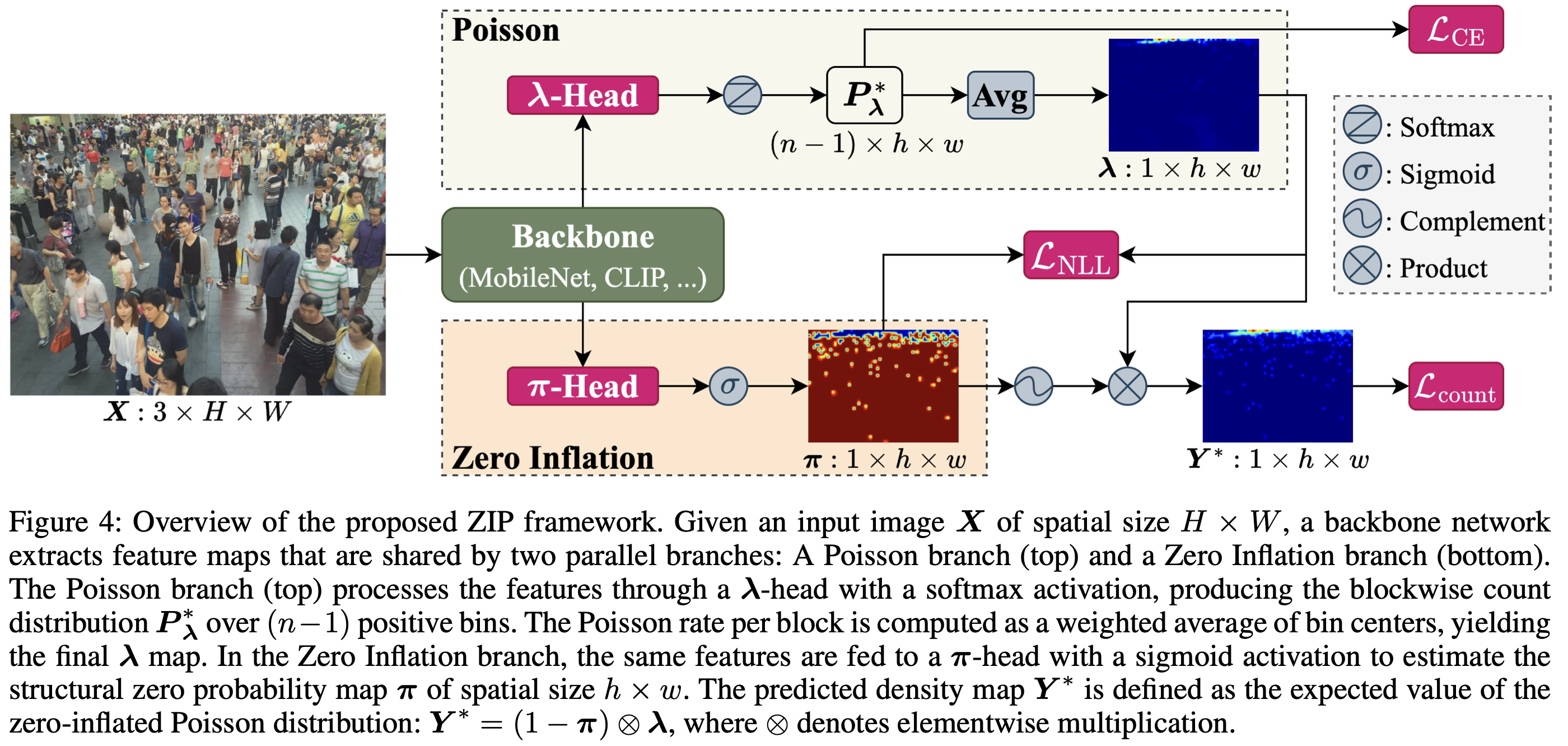
ZIP predicts two quantities per block: a structural-zero probability for background, body parts, and other non-head-centre regions, and a Poisson rate for candidate head-centre regions. Integer count bins stabilize rate prediction, while the joint likelihood learns the distinction between structural zeros and sampling zeros directly from point annotations.
03 / Evidence
What does the current evidence show?
With the same VGG19 backbone, ZIP lowers MAE relative to EBC by 3.2%-14.2% across ShanghaiTech A/B, UCF-QNRF, and NWPU-Crowd validation. Five variants from 0.81M to 105.60M parameters improve monotonically with scale; ZIP-B reaches 69.46 MAE on UCF-QNRF and 60.1 MAE / 0.104 NAE on the NWPU-Crowd test set.
04 / Limits
Where are the limits of this work?
The current preprint uses dataset-specific count bins, block sizes, and training resolutions. Its failure analysis still finds false positives on person-shaped objects and missed low-contrast heads; on NWPU-Crowd test, its RMSE is competitive rather than best.