ZIP: Scalable Crowd Counting via Zero-Inflated Poisson Modeling
TL;DR
Over 95% of 8×8 blocks in crowd-counting benchmarks are empty, and MSE ignores that counts are discrete and non-negative; ZIP models blockwise counts with a zero-inflated Poisson likelihood instead, achieving state-of-the-art or highly competitive results across backbones spanning more than 100× in size.
Abstract
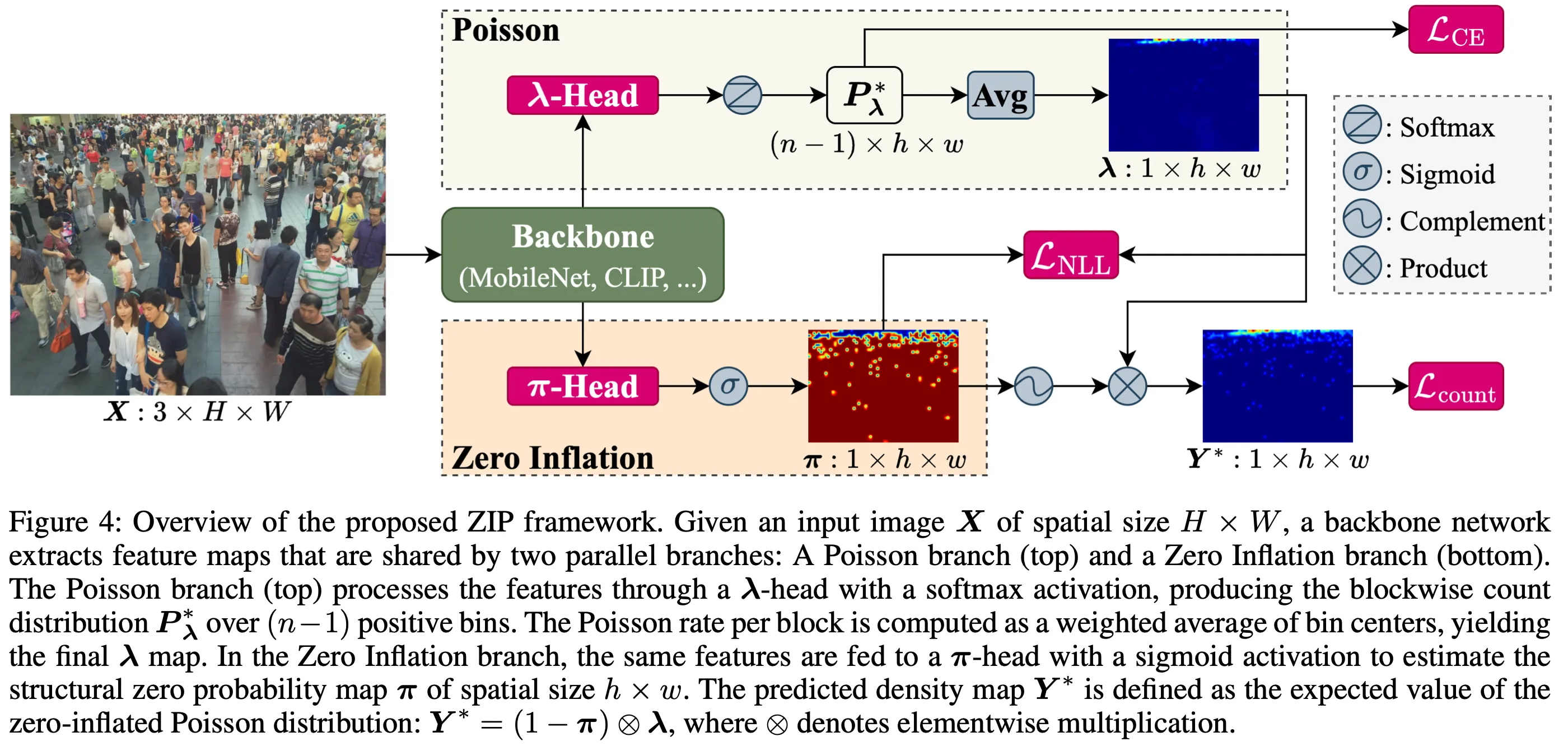
The majority of crowd counting methods directly regress blockwise density maps using losses based on Mean Squared Error (MSE). This practice has two critical limitations: 1) it fails to account for the extreme spatial sparsity of annotations (i.e., over 95% of standard 8×8 blocks are empty across most benchmarks), which makes supervision signals in informative regions diluted by the predominant zeros. 2) MSE corresponds to a Gaussian error model that poorly matches discrete, non-negative count data. We introduce a novel crowd counting framework that is scalable and directly addresses the above limitations. This framework, named ZIP, models blockwise counts with a Zero-Inflated Poisson likelihood: A zero-inflation term models excess zeros in sparse annotations, while the Poisson component captures expected counts while respecting their discrete, non-negative nature. We provide a generalization analysis showing that the ZIP negative log-likelihood (NLL) has the same order of uniform generalization gap as Poisson NLL while offering a richer zero-inflated likelihood family, and that its bound scales more favorably with the number of spatial blocks than optimal-transport-based supervision. To assess the scalability and broad applicability of ZIP, we apply the same formulation across diverse backbones, from lightweight models to high-capacity architectures, spanning more than 100× in both parameter count and inference FLOPs. Experiments on four standard crowd-counting benchmarks show that ZIP achieves state-of-the-art or highly competitive performance across a wide range of backbone capacities. Although ZIP is designed for sparse blockwise count maps, it also remains effective in dense crowd scenes, reducing MAE and RMSE by 3.9% and 8.5%, respectively, over mPrompt on UCF-QNRF. Code and trained weights are available at https://github.com/Yiming-M/ZIP.
Cite
@ARTICLE{11797788,
  author={Ma, Yiming and Sanchez, Victor and Guha, Tanaya},
  journal={IEEE Transactions on Image Processing},
  title={ZIP: Scalable Crowd Counting via Zero-Inflated Poisson Modeling},
  year={2026},
  doi={10.1109/TIP.2026.3752245}}